ACV Gummy Side Effects: What the Research and Labels Show
Quick Answer: What Are the Side Effects of ACV Gummies?
Most people who react at all react mildly, and they react in the gut. The reported effects are nausea, an acidic or burning feeling in the throat, gas, looser stools and occasional cramping — usually in the first week, usually worse on an empty stomach, and usually settling as the routine becomes habitual. Two effects are specific to the gummy format rather than to vinegar: acid and sugar sitting on the teeth, and a sweetened base that is easy to over-eat. The effects worth taking seriously come from the other ingredients travelling in these formulas, not from the vinegar.
- Most common: mild digestive upset in the first week.
- Format-specific: dental acid exposure, and added sugar.
- Stop and ask: dark urine, jaundice, severe pain, swelling.
Why the gummy format changes the side-effect picture
Liquid vinegar has one well-known problem: it is unpleasant, and neat vinegar is hard on tooth enamel and the throat. A gummy solves the taste problem, which is why the format exists. It does not remove the acid; it changes how the acid arrives.
Three consequences follow. A chewed gummy holds acid against the teeth longer than a swallowed capsule does, so the dental exposure is real. The gummy base carries sugar — typically a gram or two per serving — which is trivial at one a day and much less so if someone treats a sweet supplement like a sweet. And the dose is usually smaller than the liquid amounts used in trials, which cuts both the potential benefit and the intensity of any acid complaint. That trade-off is covered in more detail in our review of the human trial evidence on apple cider vinegar and weight.
The side effects people actually report
The everyday complaints with vinegar-based products are consistent and unremarkable. A safety and tolerance study of medicinally ingested vinegar in adults with type 2 diabetes found it broadly tolerated, with nausea the complaint that showed up most. That matches practice: a mild queasiness or acidic feeling for the first few days, worst on an empty stomach.
The rest of the list is short: gas or a change in stool consistency in the first week, and occasionally reflux symptoms getting temporarily worse. Plain apple cider vinegar at food-level doses is one of the lower-risk things in this aisle. That is not the same as risk-free, and it says nothing about the other ingredients a weight-management gummy may carry.
Do apple cider vinegar gummies damage tooth enamel?
Acid softens enamel; that is chemistry, not controversy. The practical question is exposure time and frequency. Sipping vinegar through the day is the worst pattern. A single gummy chewed once a day is a far smaller exposure, but it is longer contact than a capsule and it comes with sugar attached.
Three habits reduce the risk almost to nothing: take it with a meal rather than alone, rinse the mouth with plain water afterwards, and wait roughly half an hour before brushing. That last one is counter-intuitive and matters most — brushing straight after an acid exposure scrubs enamel while it is still softened. Anyone with existing erosion, sensitivity or a history of dental work should raise it with a dentist before making a daily habit of any chewable acid product.
Banaba leaf side effects: what has actually been reported
Banaba leaf turns up in glucose-adjacent weight formulas often enough that its safety gets asked about a lot. The honest answer is that the human record is small. The published review of banaba and corosolic acid efficacy and safety describes it as well tolerated in the short trials that exist, with no consistent adverse pattern. Those trials enrolled a few dozen people for two weeks or less, so "no signal found" mostly means "few people looked".
The meaningful caution comes from the mechanism rather than the reports. If an ingredient may lower glucose, it can add to the effect of a medicine that lowers glucose, and the result of stacking those is hypoglycaemia rather than an improvement. That is a pharmacist conversation, not a comment-section one. The wider picture on what this ingredient can and cannot do is in our piece on banaba leaf, corosolic acid and the gap between marker compounds and results.
DGL and licorice gummy side effects: the label word that matters
This is the ingredient in the category with the clearest documented harm, and it hinges on a single label term. Ordinary licorice root contains glycyrrhizin, which blocks an enzyme in the kidney and lets cortisol behave a little like aldosterone. The body then holds sodium and water and sheds potassium, and the result — raised blood pressure, low potassium, sometimes swelling — is described in detail in the liquorice toxicity literature.
Deglycyrrhizinated licorice, sold as DGL, has most of that compound stripped out, which is precisely why the processing step exists. So a "DGL gummy" and a "licorice gummy" are not interchangeable, and the label word is doing real safety work. If a panel says licorice root without saying DGL, you have not been told which one you are holding. Our explainer on what DGL actually means on a licorice label walks through the distinction and the amounts involved.
The ingredients that carry a genuine safety signal
Most weight-management botanicals are, at worst, inert. A handful are not, and they deserve naming rather than being treated as equally benign.
Concentrated green tea extract. Drinking green tea has an excellent safety record; high-dose extract is a different material, and it appears in registry data on liver injury from herbal and dietary supplements. The risk is small in absolute terms and concentrated in high doses taken fasted. The detail sits in our review of the EGCG and caffeine evidence for green tea extract.
Berberine. Effective enough to be worth taking seriously and rough enough on the gut to be the main reason people stop. Reviews of berberine in metabolic disease describe diarrhoea, constipation, cramping and gas as dose-related and common, and berberine also interferes with how the liver processes a range of other drugs. See what the berberine blood-sugar trials actually show for the full picture.
Viscous fibres. Glucomannan carries one hazard that is not mild: taken dry or with too little liquid it can swell in the throat or oesophagus. It is a real, documented risk with a completely effective fix, which is water. The dosing rules are set out in our piece on glucomannan, appetite and the water rule.
Garcinia cambogia. Rare but repeatedly reported liver injury, attached to an ingredient whose benefit is marginal at best. That combination — little upside, small but real downside — is what makes it hard to justify. We cover it in the garcinia cambogia evidence and its safety signal.
Side effects by ingredient, at a glance
| Ingredient | Most common effects | Serious signal? |
|---|---|---|
| Apple cider vinegar | Nausea, throat burning, dental acid exposure | No, at food-level doses |
| BHB mineral salts | Contribute sodium; GI upset at gram doses | No, at label-level milligrams |
| Banaba leaf | Well tolerated in short, very small studies | Not reported; little studied |
| Licorice root (with glycyrrhizin) | Raised blood pressure, low potassium | Yes — documented case reports |
| Berberine | Diarrhoea, cramping, drug interactions | Interaction risk, not organ toxicity |
| Green tea extract (high dose) | Nausea; rare liver injury | Yes — rare but recorded |
| Garcinia cambogia | Mild digestive upset; rare liver injury | Yes — rare but recorded |
| Glucomannan | Bloating, gas; choking if taken dry | Yes — if the water rule is ignored |
The pattern is worth noticing: the ingredients with the strongest effects are the ones with the strongest side effects, and the ones with no side effects usually have no effects either.
Want to see the panel before you decide?
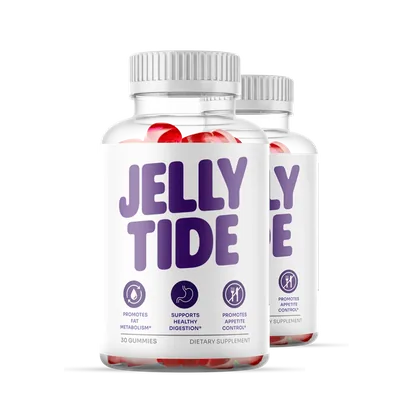
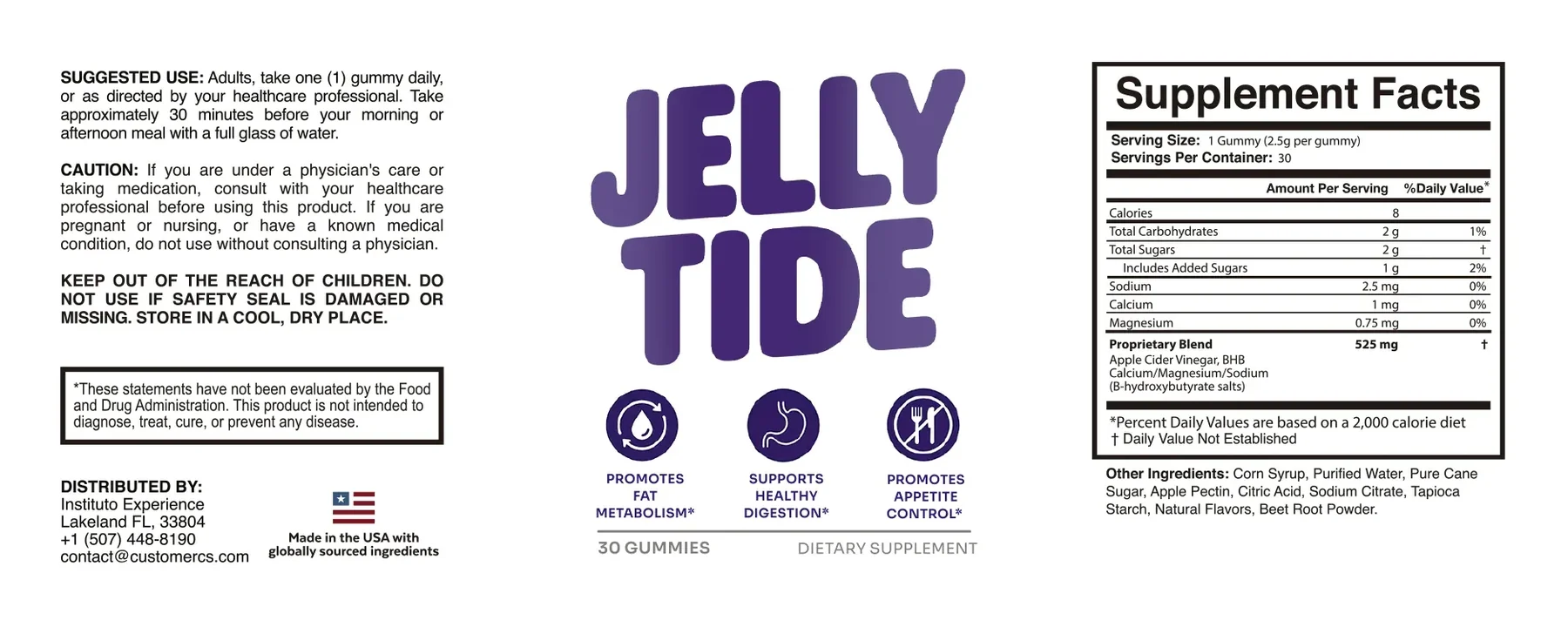
Side-effect risk is decided by what is actually in the bottle and how much of it. JellyTide keeps to apple cider vinegar with BHB calcium, magnesium and sodium salts in one 525 mg blend, on a five-line panel we reproduce in full.
See the JellyTide label and ingredientsWhat the label cannot tell you
There is a gap in this whole discussion that deserves stating. Predicting side effects assumes the panel is accurate, and that assumption does not always hold. Independent laboratory work published as a label-accuracy analysis of weight-loss dietary supplements sold online found products whose measured contents did not match what the label declared, including ingredients present that were never listed.
That is a reason to prefer short panels over long ones, and named amounts over proprietary blends. Where several actives sit inside one blend total, as they do on a great many gummy labels, you cannot work out how much of anything you are taking — so you cannot predict how much you are risking. That applies to the product this site covers as much as to any other.
The scale of real-world harm is worth keeping in proportion. Analysis of emergency department visits for adverse events related to dietary supplements put the annual figure in the tens of thousands in the United States, concentrated in weight-loss and energy products, and heavily weighted toward young adults and older people. Tens of thousands is a small fraction of the doses taken, and it is not zero.
Who should not take an ACV gummy
Some groups should not start without a clinician's input, and the list is short enough to read in full. Anyone pregnant or nursing. Anyone under eighteen. Anyone taking glucose-lowering medication, because an ingredient that nudges glucose down adds to a drug that pushes it down harder. Anyone on diuretics, digoxin, or anything that affects potassium, particularly where licorice is on the panel. Anyone with chronic kidney disease, since mineral salts and potassium handling stop being trivial.
Then the conditional cautions. Reflux, gastritis or an ulcer make an acidic product uncomfortable. Gastroparesis or delayed stomach emptying is a reason to avoid anything that slows emptying further — awkwardly, the same mechanism that gives vinegar its glucose effect. A history of dental erosion makes a daily chewable acid a dental decision. And anyone managing a diagnosed condition should treat this as a medical conversation rather than a shopping one.
How to reduce side effects: a practical routine
Almost all of the mild complaints are avoidable with four habits, and none of them is difficult.
Take it with food, not on an empty stomach. This removes most of the nausea and the acidic-throat feeling in one move, and it is the timing the glucose research supports anyway.
Start at the low end for a week. If a label allows one or two gummies, take one. Nearly every dose-related complaint here is worse when someone starts at the maximum on day one.
Rinse, and delay brushing. Plain water afterwards, and about thirty minutes before the toothbrush.
Do not stack. People run into trouble by taking a gummy, a fat-burner and a stimulant drink that share ingredients. Read the panels side by side before adding anything new.
When to stop and seek advice
Mild and improving is one thing; the following are another, and none of them is a normal supplement side effect. Dark urine, yellowing of the skin or eyes, or unusual and persistent fatigue can indicate liver trouble and warrant prompt medical advice. Severe or ongoing abdominal pain is not a settling-in effect. Muscle weakness, cramping, a racing heartbeat or swelling in the ankles can point to a potassium problem, which is the specific thing to watch for where licorice is involved.
There is also a quieter threshold worth naming: if mild digestive upset has not settled within about two weeks, stop. A product you cannot comfortably take every day cannot help you, because adherence is the whole mechanism by which any daily supplement does anything at all. Judging that trade-off sensibly is part of the same skill set as reading the studies, which we set out in how to read a weight-loss study without being misled.
What the evidence shows, and what it does not
What it shows: vinegar at food-level doses is well tolerated in short human studies, with nausea the main complaint; licorice with glycyrrhizin has a documented, mechanistically explained effect on blood pressure and potassium; concentrated green tea extract and garcinia both appear in liver-injury registries; and supplement labels are not always accurate about what is inside.
What it does not show: that ACV gummies are risk-free, that a finished multi-ingredient product has been safety-tested as sold, or that long-term use is safe, because almost every trial here runs for weeks. Absence of a reported problem in a two-week study of thirty people is weak reassurance, not a clean bill of health.
Medical note: this article is general information, not medical advice, and it cannot account for your medicines or medical history. Speak to a qualified healthcare professional before starting any supplement, especially if you are pregnant, nursing, taking medication or managing a health condition. Seek prompt advice for any symptom described above as a reason to stop.
Related reading
Scientific references
- Geller AI, Shehab N, Weidle NJ, Lovegrove MC, et al. — Emergency department visits for adverse events related to dietary supplements, N Engl J Med (2015)
- Navarro VJ, Khan I, Björnsson E, Seeff LB — Liver injury from herbal and dietary supplements, Hepatology (2017)
- Crawford C, Avula B, Lindsey AT, et al. — Label accuracy of weight loss dietary supplements marketed online, JAMA Network Open (2024)
- Johnston CS, White AM, Kent SM — A preliminary evaluation of the safety and tolerance of medicinally ingested vinegar in individuals with type 2 diabetes, J Med Food (2008)
- Ceccuzzi G, Rapino A, Perna B, Costanzini A, et al. — Liquorice toxicity: a comprehensive narrative review, Nutrients (2023)
- Stohs SJ, Miller H, Kaats GR — A review of the efficacy and safety of banaba (Lagerstroemia speciosa L.) and corosolic acid, Phytother Res (2012)
- Xu X, Yi H, Wu J, Kuang T, et al. — Therapeutic effect of berberine on metabolic diseases: pharmacological data and clinical evidence, Biomed Pharmacother (2021)
Frequently asked questions
What are the side effects of ACV gummies?
The common ones are digestive and mild: nausea, an acidic or burning feeling in the throat, gas, looser stools and occasional stomach cramping, usually in the first week and usually worse on an empty stomach. Because gummies are chewed, added sugar and acid also sit on the teeth, so dental erosion is a real if slow risk. Anything beyond mild and short-lived is a reason to stop and speak to a healthcare professional.
Do apple cider vinegar gummies damage tooth enamel?
They are gentler than sipping neat vinegar, which is genuinely bad for enamel, but they are not neutral. A chewed gummy holds acid and sugar against the teeth for longer than a swallowed capsule would. The practical fix is to take it with a meal, rinse with plain water afterwards and wait about thirty minutes before brushing, because brushing immediately after an acid exposure scrubs softened enamel.
What are banaba leaf side effects?
Short human studies of banaba leaf and corosolic acid reported it as well tolerated, with no consistent pattern of adverse effects. That is reassuring rather than conclusive, because those studies enrolled very few people for two weeks or less. The clearest theoretical caution follows from the mechanism: anything that may lower glucose can add to the effect of glucose-lowering medicines, which is a conversation for a pharmacist.
Do DGL or licorice gummies have side effects?
Ordinary licorice can raise blood pressure and lower potassium through its glycyrrhizin content, and case reports of that effect are well documented. Deglycyrrhizinated licorice, sold as DGL, has most of that compound removed and largely sidesteps the problem. The label word matters: a product that says licorice root without saying DGL has not told you which of the two you are buying.
Who should not take an ACV gummy?
Anyone who is pregnant or nursing, anyone under eighteen, and anyone taking glucose-lowering medication, diuretics, digoxin or potassium-affecting drugs should speak to a clinician before starting. People with reflux, gastritis, an ulcer, delayed stomach emptying, chronic kidney disease or a history of dental erosion have specific reasons for caution. Anyone managing a diagnosed condition should treat this as a medical conversation, not a shopping decision.
When should you stop taking a weight-loss gummy?
Stop and seek medical advice for dark urine, yellowing of the skin or eyes, unusual or persistent fatigue, severe or ongoing abdominal pain, muscle weakness or cramping, a racing heartbeat, or swelling in the ankles. Those are not typical supplement side effects. Mild digestive upset that has not settled within two weeks is also a reasonable reason to stop, because a product you cannot tolerate cannot help you.
One short label, read in full
Apple cider vinegar with BHB calcium, magnesium and sodium salts in a single daily gummy — a five-line panel and a stated 525 mg blend total.